
Mobile Apps Are Not Websites. Your Hosting Cannot Be Either
You built an app. It works great on your computer. You push it to a cheap hosting provider because it worked for your website.
Then users start downloading it. The app is slow. Requests timeout. Data does not sync properly. Users leave bad reviews.
The problem is not your app. The problem is you are trying to run app infrastructure on web hosting.
What Mobile Apps Actually Need
A website sits on a server. Someone visits the URL. The server sends HTML. Done.
A mobile app is different. Your app is running on thousands of devices simultaneously. Each device is constantly talking to your backend. Sending data. Requesting data. Syncing. Authenticating.
This is not the same architecture as a website.
The Backend vs Hosting Difference
Web hosting companies sell you server space. You put files on it.
App backend infrastructure is about APIs, databases, real-time sync, authentication, push notifications, and scaling.
A cheap hosting provider can run your website. They cannot run your app properly.
What Your App Backend Actually Needs
API servers: Fast response times. Your app makes requests constantly. Every millisecond of delay is lag your users feel.
Database: Not just any database. One that handles concurrent requests from thousands of devices at once. SQLite works for learning. PostgreSQL or MongoDB works for real apps.
Authentication: Users login, logout, sessions persist, tokens expire safely. This is complex plumbing most web hosts do not handle well.
Real-time sync: If your app syncs data between devices, you need WebSocket support or similar. Traditional web hosting does not always have this.
Push notifications: Your app sends notifications to users. The infrastructure for this is completely different from website hosting.
Scaling: One user downloads your app. Then ten thousand do. Your infrastructure needs to handle that without crashing.
Why Cheap Hosting Fails For Apps
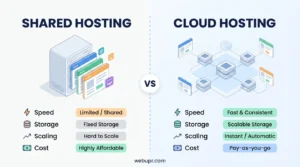
Cheap hosts oversell resources. They expect most sites to be idle most of the time. A website gets traffic in bursts. An app has constant connections.
The moment your users exceed what the shared server can handle, everything degrades. Your app becomes unusable.
Also, cheap hosts do not care about API performance. They optimize for serving static files. Your app makes API calls, not requests for static files.
The Cloud Hosting Advantage
Cloud platforms (AWS, Google Cloud, Azure) are built for exactly this. Scaling happens automatically. Your API performance stays fast even as users increase.
They handle databases, authentication, real-time sync, push notifications. All the infrastructure your app needs.
Downside: They are more expensive than cheap web hosting. And they require more technical setup.
The Middle Ground Solutions
Firebase by Google handles a lot of app backend for you. Authentication, database, real-time sync, push notifications. You write your app, Firebase handles the infrastructure.
The cost is reasonable for small to medium apps. Scaling happens automatically.
Supabase is an open-source alternative. Similar features, lower cost.
Backend-as-a-service platforms like these are actually ideal for most mobile apps.
Server Architecture Matters
If you are running your own backend (not using a service like Firebase), you need the right architecture.
Load balancing: Requests distributed across multiple servers so no single server is overwhelmed.
Database replication: Your data backed up across multiple machines so a single failure does not lose everything.
Caching layers: Redis or Memcached to make repeated requests fast.
CDN for content: Images and files served from servers near your users.
Cheap hosting provides none of this. You get a single server with no redundancy.
The Cost Reality
A proper app backend costs. Firebase starts free and scales based on usage. Cloud platforms cost money but scale automatically.
The cost is worth it because your app actually works. Users stay. You can charge for your app and make that money back.
Running your app on cheap hosting is penny wise and pound foolish. You lose users to bad performance and make nothing.
API Rate Limiting and Throttling
Your app makes API requests. If requests are unlimited, your backend gets crushed.
Good app hosting includes rate limiting: users can make X requests per minute. This protects your backend from overload.
Cheap hosts do not have this. Your backend is vulnerable.
Latency Matters More Than You Think
A website where pages load in three seconds feels slow but acceptable.
An app where API responses take three seconds feels broken. Users expect responses in under 500 milliseconds.
Your app hosting needs to be fast. Geographically distributed. With servers near your users.
Cheap hosting in one location cannot deliver this.
Data Privacy and Security
Apps often handle sensitive user data. Location, health information, personal details.
Your hosting needs to handle this securely. Encryption at rest. Encryption in transit. Compliance with privacy laws.
Cheap hosts are not built for this. Cloud platforms have security built in.
Monitoring and Alerts
With a website, you might not notice if it is down for an hour.
With an app, downtime means users cannot use your product. You need real-time monitoring and alerts.
Good app hosting gives you dashboards showing API performance, error rates, user activity.
Cheap hosting gives you nothing.
Database Performance Under Load
Shared hosting often has slow databases because they are shared with hundreds of other sites.
App databases need to handle thousands of concurrent requests. The database needs to be optimized for this.
Query optimization, indexing, connection pooling. These things require proper database infrastructure.
The Startup Dilemma
You are building an app and budget is tight. You want cheap hosting to save money.
Do not do this. Your app will be slow. Users will leave. You will fail.
Start with Firebase or Supabase. They are affordable and actually work. Scale from there.
Cheap hosting is a trap. It looks cheap but costs you everything.
Migration Is Painful
You launch on cheap hosting. Users start using your app. Then performance gets bad.
Now you need to migrate to better infrastructure. Moving a live app with users is painful and risky.
Start with proper infrastructure from day one. It costs a bit more upfront but saves you massive headaches.
The Comparison
Check Google Cloud hosting and AWS for serious app infrastructure.
Use Firebase for faster setup with less configuration.
Never, ever use cheap web hosting for your app backend.
Final Thoughts
Your app deserves infrastructure designed for apps, not websites. This is non-negotiable.
Spend money on proper backend hosting. Your app will be fast, reliable, and scalable. Users will have a good experience. You will actually build something people want to use.
Cheap hosting is not savings. It is sabotage.