
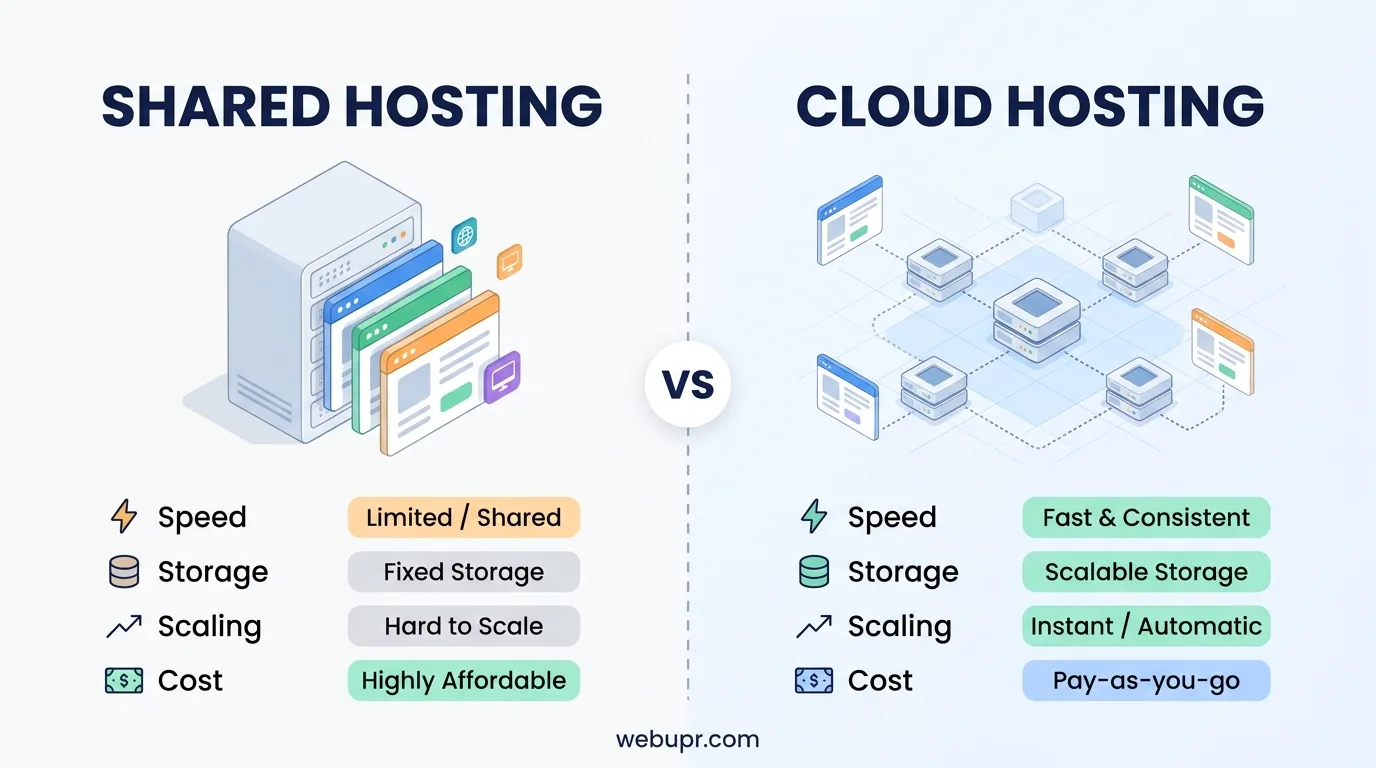
Two Ways to Put a Website Online, and Very Different Trade-Offs
When people first start looking for hosting, they often see two options that sound like the same thing. Shared hosting is cheap and simple. Cloud hosting sounds more powerful and more modern. Both can put your site online, but they work in very different ways, and the right choice depends on what your site needs and who will look after it.
This guide explains how each one works, where each one shines, and how to decide without paying for power you will never use or squeezing a growing site onto a plan that cannot keep up.
What Shared Hosting Actually Is
Shared hosting means your website lives on a server that also hosts many other websites. The provider takes care of the server itself, the operating system, security updates, and most of the software. You get a control panel, a fixed allocation of storage and bandwidth, and a simple way to upload files or install an app like WordPress.
The main appeal is that it is easy. You do not need to understand servers to get started. Most providers offer one click installs and support for common tools, which makes shared hosting a good first home for a small site.
The trade-off is that resources are shared. If a neighbouring site suddenly gets a lot of traffic, your site can feel slower for a while. Good providers limit this, but it is still a fact of life on shared plans.
What Cloud Hosting Actually Is
Cloud hosting spreads your website across a network of servers rather than one machine. Resources such as processing power, memory, and storage can be added or reduced as needed. You often pay for what you use, rather than a fixed monthly bundle.
The appeal is flexibility. If your site gets a sudden burst of visitors, the platform can add capacity to handle it. If the traffic settles down, you can scale back. This makes cloud hosting a strong fit for growing businesses, custom applications, and sites that need to stay fast under unpredictable demand.
The trade-off is complexity. Cloud platforms give you more control, but that means more decisions. You may need to configure servers, set up backups, manage security rules, and keep an eye on billing. Usage-based pricing is flexible, but it can also surprise you if you are not watching.
Cost: The Headline Number Is Only Part of the Story
Shared hosting usually has a predictable monthly price. You know roughly what you will pay each month, and renewal prices are easy to compare. That predictability is a big reason people choose it.
Cloud hosting can be cheaper for very small workloads, but it is harder to predict. Your bill depends on compute time, storage, data transfer, and any extra services you add. A quiet month costs little. A busy month, or a misconfigured service left running, can cost much more. Set budget alerts from the start if you go this route.
If you want a rough estimate before committing, the official Google Cloud free program page is a good place to see what is included and what starts to cost money.
Performance and Scaling
For a small brochure site or a personal blog, shared hosting usually performs well enough. Pages load quickly when traffic is modest, and a good provider keeps the server responsive.
Cloud hosting shines when traffic grows or changes quickly. A product launch, a viral post, or a seasonal rush can be handled by adding capacity instead of hoping the server copes. For sites that need to stay fast under pressure, that flexibility matters a lot.
Control and Responsibility
Shared hosting gives you less control, but also less to worry about. The provider handles most of the infrastructure, and your job is mainly to manage the content and keep your software updated.
Cloud hosting gives you much more control. You can choose the operating system, install custom software, and set exact security rules. That freedom comes with responsibility. Patching, backups, firewall rules, and access management become your job, or the job of a developer you hire.
Security Considerations
Both options can be secure when set up well. On shared hosting, the provider usually handles server level security, but you still need strong passwords, current software, and a tidy plugin list. A weak site can still get hacked on a shared server.
On cloud hosting, the provider secures the underlying infrastructure, but you secure what you build on top of it. Access rules, open ports, and stored data are your responsibility. Many cloud problems come from misconfiguration rather than from the platform itself.
Who Should Choose Shared Hosting
Shared hosting suits personal websites, small business brochure sites, local service pages, and simple blogs. It also suits people who want a control panel, one click installs, and a provider that answers the phone when something breaks.
If you are comparing budget options, our guide on Hostinger vs Namecheap looks at two popular shared hosting providers in more detail.
Who Should Choose Cloud Hosting
Cloud hosting suits growing businesses, online stores with variable traffic, custom web applications, APIs, and teams that already have someone comfortable with servers. It also suits sites that need to scale quickly without a migration project.
If you are considering Google Cloud specifically, our article on hosting in Google Cloud explains who it suits and who should skip it.
The Middle Ground
Many sites sit between these two options. Managed WordPress hosting, VPS plans, and platform as a service products try to offer the simplicity of shared hosting with more room to grow. If you outgrow shared hosting but are not ready for full cloud complexity, look at these options before jumping straight to a complex setup.
Migration Is Easier Than It Sounds
Many people worry about getting stuck. Moving from shared hosting to cloud hosting, or back again, is a normal project. Back up your files and database, set up the new environment, test the site on a temporary address, and then update your DNS when everything works. Plan the move for a quiet time and keep the old host running until you are sure.
A Simple Way to Decide
Ask three questions. How much traffic do you expect, and how steady is it? Who will manage the server, and how comfortable are they with technical tasks? How predictable does your monthly budget need to be?
If your traffic is modest, your budget is fixed, and you want someone else to handle the server, shared hosting is usually the right call. If your traffic is growing or unpredictable, you need more control, and you have someone to manage it, cloud hosting is worth the extra work.
The Bottom Line
Shared hosting trades flexibility for simplicity and predictable cost. Cloud hosting trades simplicity for power, scale, and control. Neither is better in every case. Start with the one that matches your traffic, your skills, and your budget today, and keep an eye on the signs that tell you it is time to move.